
11th Aug 2026
The Complete Guide to Hospitality Uniforms
In hospitality, the uniform is part of the service. It's the first thing a guest registers when they walk in, before the menu, the music or the fitout has had a chance to say anything. It tells them what kind of venue this is, and usually how much it costs.
It also has to survive a ten-hour shift on a hard floor, around heat, oil, red wine and constant movement. Hospitality uniforms have to do brand work and hard physical work at the same time, which is what makes them one of the more demanding categories to get right. This guide covers how to choose them by role, which fabrics stand up to the work, and the details that separate a uniform that looks good on day one from one that still looks good six months in.
Start with the venue, not the garment
Before choosing anything, it's worth being clear about what your venue is. A specialty coffee bar, a mid-range bistro and a fine dining restaurant sit at three very different points, and the uniform should sit at the same point as the food, the fitout and the price.
A useful test: would this uniform look out of place if a guest photographed it and posted it? If the answer is yes in either direction, whether too casual or trying too hard, it's worth adjusting.
Front of house
Your front of house team is the most visible element of your brand, so restaurant uniforms here need to look sharp late in a shift, not just at the start of one.
Casual venues and cafes. Branded tees and polos, denim or chino, and a quality apron. Cafe uniforms work best when they're comfortable enough to move quickly in and relaxed enough to suit the room. Mid to darker tones handle the inevitable coffee splash. A well-made apron does most of the visual work here, since it's the piece guests actually look at.
Bistro and mid-range. Business shirts or premium polos, tailored pants, and a bib or waist apron. This is where fabric quality begins to show, because an inexpensive shirt looks inexpensive under warm restaurant lighting.
Fine dining. Structured shirting, tailored trousers, and sometimes waistcoats or jackets. Fit and fabric are the entire proposition. A wrinkle-resistant, cotton-rich shirting with a small elastane content holds a press through service while still allowing movement.
Bar staff. Movement, spills and heat all in one role. Prioritise fabrics that dry quickly and stay opaque when wet, and lean towards darker colours. Rolled or short sleeves are more practical than they might appear.
Kitchen and back of house
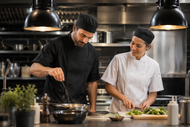
The brief here is entirely different. Safety, heat management and hygiene come first and appearance second, with the exception of open kitchens, where chef's whites have become part of the dining room.
Chef wear. Traditional whites still dominate for good reason, since they show contamination clearly, which is a hygiene feature rather than a stylistic one. Look for breathable cotton or poly-cotton, mesh or vented panels through the back and underarm, and double-breasted fronts where the traditional look is preferred. Modern lightweight chef jackets have improved considerably on heat management.
Kitchen hands and dish. Durable, easily washable, and affordable enough to replace on a sensible cycle. Poly-cotton tees and heavy-duty aprons cover it.
Aprons. The hardest-working garment in the building. Choose heavy cotton canvas or drill, reinforced stitching at the strap joins, and pockets positioned where they can actually be reached. Bib aprons suit kitchen and barista work, waist aprons suit floor service. Budget to replace them more often than anything else in the range.
Footwear. Not usually a uniform item you'll supply, but worth including in your policy: closed-toe, non-slip, and enforced. It's the most common preventable injury in the industry.
Fabric and construction that survive hospitality
The environment is unforgiving, so the specification matters:
- Poly-cotton blends around 65/35 handle frequent hot washing far better than pure cotton, resist wrinkling through a shift, and hold their colour.
- Moisture-wicking constructions are worth paying for in kitchens and busy bars.
- Colourfastness is critical, because commercial laundering fades inexpensive dye quickly, and a team wearing three different shades of the same black looks careless.
- Darker tones and patterns hide stains. Pure white is a commitment, so be confident your laundry process can support it.
- Reinforced stress points at shoulders, side seams and pockets extend garment life meaningfully.
It's worth asking specifically how a garment performs under commercial laundering if that's how you wash. Many garments rated for domestic washing degrade quickly at commercial temperatures.
Fit, sizing and the human factor
Hospitality staff are on their feet, reaching, carrying and bending for entire shifts. A uniform that restricts any of that will be resented, and it will be worn badly.
Offer men's and women's fits in the same style rather than a single unisex cut, and run a size set before the bulk order. Provide at least two garments per person for anything worn daily, since the alternative is expecting staff to wash a shirt every night.
Hospitality also carries higher turnover than most industries, so keep the core range simple, stocked and easy to reorder. A ten-piece range with unusual sizing becomes an administrative problem within a year.
Branding your hospitality workwear
Keep it restrained. In hospitality workwear, a small embroidered logo on the left chest or on the apron bib usually works better than anything larger, because guests are looking at people rather than signage.
Embroidery suits polos, shirts and aprons, and survives commercial laundering better than any alternative. Screen printing works well for casual venue tees and merchandise runs. For technical or performance fabrics, DTF transfer is the more reliable option.
One approach worth considering is branding the apron rather than the shirt. It allows staff to wear a simple base garment, places the logo at eye level, and makes the uniform much cheaper to refresh when the branding changes.
A practical starting range
For most venues, this covers it:
- A branded polo or shirt in the venue's primary colour, two per staff member
- A neutral, durable pant or skirt option
- A quality branded apron, bib or waist depending on the role
- A layering piece for outdoor or seasonal service
- Chef wear specified separately for kitchen roles
Five decisions made carefully will serve most venues far better than twenty made in a hurry.
The Uniform Lab supplies hospitality uniforms, aprons and branded workwear to cafes, restaurants, bars and hotels across Australia. Get in touch and we'll help you put a range together for your venue.