
30th Jul 2026
Embroidery vs Screen Printing vs Heat Transfer: Which Branding Method Is Right for Your Logo?
Once you've chosen the garment, one decision remains that shapes how your uniform looks, how long it lasts and what it costs: how the logo is applied.
The embroidery vs screen printing question is the one most businesses ask, but heat transfer, including DTF, has become a genuine third option — and for some applications it's the only one that works properly. Here's how the three compare, and how to match the method to the job.
Embroidery
Logo embroidery stitches your design directly into the fabric with thread, so the logo becomes part of the garment rather than sitting on top of it.
Strengths. It's the most premium finish available and comfortably the most durable, often outlasting the garment it's on. It handles industrial laundering, won't crack, fade or peel, and works well on textured and heavier fabrics where printing struggles. It's the standard for corporate polos, business shirts, jackets, caps and anything intended to look considered.
Limitations. Cost scales with stitch count, so large or highly detailed designs become expensive quickly. Fine text below around 5mm and subtle gradients don't reproduce well, because thread has a practical minimum resolution. There's a one-off digitising fee to convert artwork into stitch data, and on very lightweight knits a dense design can pucker the fabric.
Best suited to. Corporate and office uniforms, polos, business shirts, jackets, headwear, aprons, small to medium logos in left-chest or cap-front positions, and any environment where garments are laundered heavily.
Screen printing
Screen printing pushes ink through a mesh stencil onto the fabric, using one screen per colour.
Strengths. The economics at volume are hard to beat. Once the screens are made, each additional unit is inexpensive, which makes it the default for large runs of tees. Colours are vibrant and opaque, including on dark garments, and it handles large print areas such as full-front and full-back designs that would be prohibitive to embroider. The finish is soft and durable when done well.
Limitations. Setup cost per colour means it only makes financial sense above a minimum quantity, typically somewhere in the 25 to 50 piece range depending on the design. Every colour adds a screen, so multi-colour and photographic artwork becomes expensive or impractical. It isn't suited to short runs, one-offs, or personalisation such as individual names and numbers, and it works best on flat, cotton-rich surfaces, so seams, pockets, zips and technical fabrics all complicate it.
Best suited to. Event and promotional tees, teamwear, merchandise, high-volume staff shirts, large front and back designs, and simple one to three colour logos.
Heat transfer and DTF
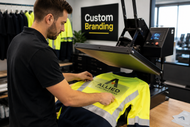
Heat transfer applies a pre-printed design to the garment using heat and pressure. Direct-to-film, or DTF, is the modern evolution: the design is printed onto a film, coated with adhesive powder, and pressed on. It has substantially expanded what's possible in this category.
Strengths. Full-colour and photographic artwork with no per-colour cost, so a complex logo costs the same as a simple one. There's effectively no minimum quantity, which makes it ideal for small orders and personalisation such as names, numbers and site or role identifiers. Importantly, it bonds well to polyester, performance fabrics, hi-vis and technical garments that screen printing and embroidery handle poorly.
Limitations. Durability sits below embroidery, and a transfer applied or washed incorrectly can crack or lift over time, although quality DTF on a suitable garment holds up well through normal laundering. Large solid areas can feel slightly heavier on the fabric than a screen print, and it isn't the cheapest option per unit at very high volumes.
Best suited to. Hi-vis and safety wear, activewear and performance fabrics, small orders, full-colour and gradient logos, personalised names and numbers, sports uniforms, and any situation where the fabric rules out the other two methods.

Choosing in practice
It helps to work through the decision in this order:
- What's the garment? Polyester, hi-vis or performance fabric points to heat transfer. A cap or a heavy jacket points to embroidery.
- How many are you ordering? Under 25 pieces generally rules out screen printing on cost. Several hundred tees makes it the obvious choice.
- How complex is the logo? More than three colours, or any gradient, and screen printing becomes expensive. Embroidery may not reproduce it at all.
- How large is the design? Full-front and back designs favour screen printing or transfer.
- How is it laundered? Commercial or high-temperature washing favours embroidery.
- What impression should it create? Embroidery reads as established and premium. A well-executed print reads as modern and approachable.
Most businesses end up using more than one method. A common arrangement is embroidered polos and jackets for customer-facing staff, screen-printed tees for events and merchandise, and DTF on hi-vis for site crews. That isn't indecision — it's matching the method to the job, which is what good uniform branding looks like in practice.
The Uniform Lab handles embroidery, screen printing and DTF in-house and can advise on the right approach for your artwork and garments. Get in touch and we'll talk you through the options.